


Cataract is a clouding of the eye’s natural lens. It may be congenital, but it most commonly develops with age.
The only effective treatment for cataracts is surgery.Cataract surgery involves removing the cloudy natural lens of the eye using ultrasound technology and replacing it with an intraocular lens (IOL).

As soon as a patient notices a decrease in visual acuity and begins to experience difficulties in daily activities, cataract surgery should be considered. Early cataract surgery enables rapid postoperative visual rehabilitation.
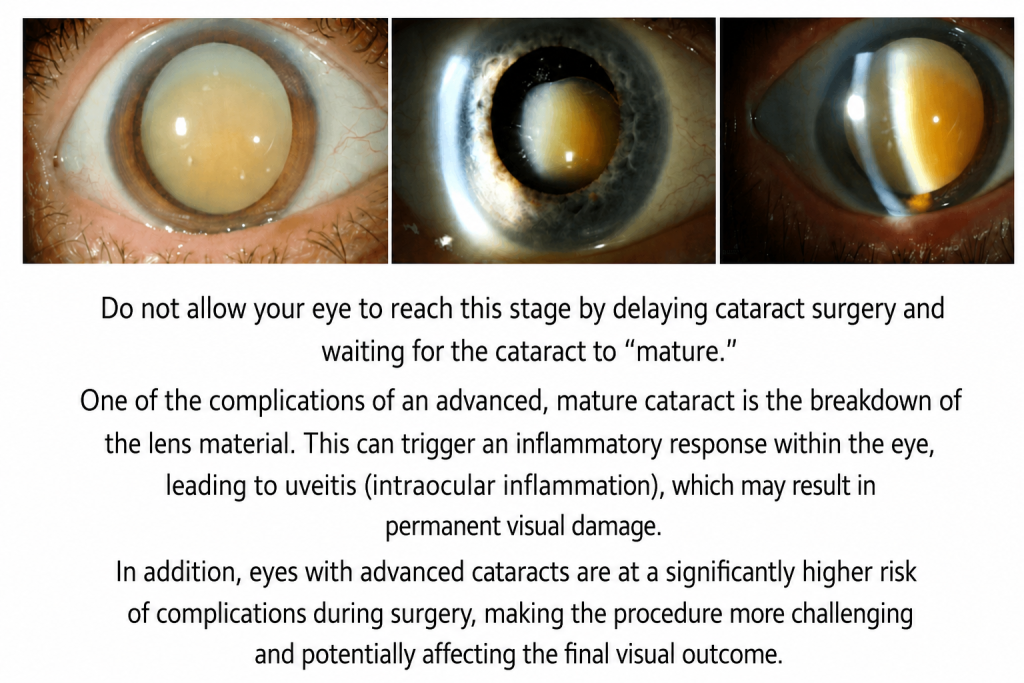
Waiting for a cataract to “mature” is an outdated approach that can lead to numerous ocular complications. It may leave the patient in a state of temporary blindness, which can result in depression, social isolation, and an increased risk of injuries and fractures.
In addition, long-standing swelling and degeneration of a dense, cloudy lens may cause permanent complications such as uveitis and glaucoma.
A dense cataract also prevents a detailed examination of the retina, making timely diagnosis and treatment of conditions such as diabetic retinopathy, glaucoma, and macular diseases impossible. As a result, irreversible vision loss may occur.
In infants and children, surgery should be performed as early as possible when the lens opacity is significant or centrally located, in order to give the child the opportunity to develop normal vision.
The procedure is usually performed on both eyes during the same surgical session.
The lens is removed using ultrasound technology (phacoemulsification), and a flexible intraocular lens is inserted through the same small incision (2mm).
The procedure is performed under topical anesthesia (eye drops), requires no stitches, and is painless.
Surgery typically takes about 10 minutes, and patients return home shortly afterward.
The protective eye shield is removed the following day, after which treatment with antibiotic and anti-inflammatory eye drops is initiated and continued for several weeks.
Cataract Surgery as a Refractive Procedure
Modern cataract surgery is also a refractive procedure, meaning that it not only removes the cataract,but can also correct refractive errors.
By selecting the most appropriate intraocular lens in consultation with your ophthalmologist, visual function impaired by cataracts can be restored, often providing clear vision immediately after surgery.
Available options include:
Monofocal Lenses-Provide clear vision at either near or distance range.
EDOF (Extended Depth of Focus) Lenses-Provide excellent vision at intermediate distances (such as computer distance) as well as far distances. Reading glasses are usually still required for close work.
EDOF Multifocal Lenses-Provide vision at all three distances—near, intermediate, and far—allowing patients to become completely independent of glasses.
*Implantation of an intraocular lens is a standard part of cataract surgery and is
performed in nearly all cases, except in certain specifically defined situations where
implantation must be postponed to a secondary procedure.
Add-On Lenses
In selected cases, patients who already have an implanted intraocular lens but remain dissatisfied with their vision may be candidates for an add-on lens.
This supplementary lens is implanted into the capsular bag behind the existing artificial lens, providing additional refractive correction without removing the original implant.
Recovery After Surgery
Recovery is typically rapid. Most patients can resume normal daily activities within a few days, while avoiding eye injuries, water exposure, and substances that may cause inflammation or irritation.
Surgical Expertise Matters
Only extensive experience in cataract surgery and the management of complex cases can provide the highest level of safety and allow patients to benefit fully from the possibilities of modern ophthalmology.
Continuous advances in cataract surgery have made it one of the most successful procedures in modern medicine.
Prof. dr. Pavel Rozsíval, with more than 40 years of experience, has contributed significantly to the development of phacoemulsification techniques and modern cataract surgery. Widely recognized by his peers for his surgical achievements, he is considered one of the most influential ophthalmologists in the advancement of eye surgery during the late 20th and early 21st centuries.